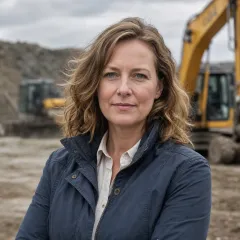
I've been coordinating equipment procurement and emergency parts delivery for five years now. In that time, I've handled more than 200 rush orders—some with 36 hours until a site deadline, a few with less. So when someone asks me the most important question to evaluate a construction equipment brand, they're usually shocked by my answer.
Stop asking where Sunward excavators are made. Ask what the maker's process guarantees you when you're under deadline and something breaks.
That might sound provocative. Let me walk you through why I say it.
When a client calls me at 4 PM on a Friday with a telehandler down and a job starting Monday morning, they aren't asking "where was that machine manufactured?" They're asking "can you get me the part, and how sure are you about it?"
The "Made In" Obsession Is a Trap
People assume "made in China" means cheaper engineering. The reality is more nuanced. Sunward manufactures in Hunan Province—one of the most concentrated construction equipment production regions in the world—and exports to dozens of countries, including Russia, Southeast Asia, and Latin America. We're not talking about a backyard workshop. We're talking about serial production at a scale most Western factories can't match.
From the outside, it looks like you can read a machine's quality from its origin label. What you don't see is the process: how components are sourced, how quality control runs between production batches, and how the factory handles a warranty claim when you're 1,000 miles from the nearest dealer.
An excavator's steel and hydraulics matter, sure. But they matter less than the process behind getting the machine to you and keeping it running. That's where the real efficiency lives.
Sunward Telehandlers Are a Case Study in Process Efficiency
Take the Sunward telehandler lineup. When people ask me "what's the best telehandler," I always push back—what's your application? How many attachments do you run? What's your lift height requirement? Those are the questions that actually save you money. The fourth question should be: how quickly can you get parts?
In March 2024, I needed a replacement hydraulic hose for a Sunward telehandler, 36 hours before a critical job. Normal parts lead time on that non-stock item was 10 days. We ended up finding a local dealer who carried the hose in inventory, arranged overnight freight, paid about $140 in rush shipping on top of the $85 base cost of the part—and the machine was running by noon that Saturday. The client's alternative was a $12,000 week-long rental.
That kind of outcome isn't luck. It's the result of a dealer network that actually carries inventory instead of drop-shipping everything from overseas. And honestly, that matters more than whether the boom weld was filmed in a flashy factory tour video.
But here's a nuance: not every Sunward dealer operates at the same level. There's a real difference between a dealer that stocks genuine parts locally and one that orders everything from the home plant. So ask about parts availability before you buy. That's a five-minute phone call that can save you from a six-week wait later.
The Air Conditioning Compressor Test
Here's something that surprises people. I often use the AC compressor in the cab—yes, the air conditioning compressor—as my test for how seriously a manufacturer treats reliability.
An AC compressor on a 3.5-ton mini excavator sounds like a minor detail. It's not. When it fails, the cab becomes a rolling sauna, operators start taking unscheduled breaks, and in a 12-hour shift, that lost productivity adds up to far more than the cost of the part itself.
The reason I respect Sunward's process is that they don't treat the AC system as an afterthought. The compressor is spec'd from a known supplier, the refrigerant lines are routed for serviceability, and replacement units are reasonably available through the parts network. That kind of thinking—designing for repair, not just for assembly—tells you more about a factory than any country-of-origin label.
And it's not just heavy equipment. I've seen the same pattern in the most unexpected places. Take a nail drill—a dentist's or manicurist's rotary tool, a precision instrument with a high-speed chuck. The cheap ones fail when the chuck heats up under load. The good ones use hardened chucks and are built so you can actually service the motor instead of throwing the whole unit away. Same lesson, smaller scale: component quality and serviceability beat brand stories.
The Hard Lesson I Learned
Honestly, I didn't always think this way. In my first year coordinating equipment deliveries, I made the classic rookie mistake: I trusted a brand's reputation without investigating its support structure. I'd compared specs, read reviews, analyzed lift capacities. What I didn't do was check parts availability.
That decision cost me. We had a machine down for 22 days waiting on a part that a better-networked manufacturer would have shipped in three. The client was furious, and we lost their subsequent order—which would have been worth around $30,000. I still kick myself when I think about it.
What did I change? I built a verification checklist that I now use for every new equipment source:
- Where is the nearest dealer, and how far away are they really?
- What does their parts inventory look like—actual stock or catalog orders?
- How long does a warranty claim take in practice, not in the sales brochure?
- What do current owners say about response time, not just machine quality?
It was only after building that checklist that I realized an uncomfortable truth: the efficiency of a product isn't in the product alone. It's in the process that surrounds it.
What About the "Are You Smarter Than a 3rd Grader" Questions?
I know that seems like a strange place to land in an article about construction equipment. But stick with me.
There's a reason those are you smarter than a 3rd grader questions are so revealing. Most adults overthink simple problems. "If a train travels at 60 miles per hour, how long does it take to go 30 miles?" A third grader says half an hour. A grown adult might start talking about acceleration curves and railway signaling and miss the point entirely.
The equipment business works the same way. We overcomplicate. We debate trade policy, brand positioning, market share. Meanwhile, the basic question—"will this machine work for my job, and can I get it repaired fast when it doesn't"—goes unanswered.
That's why I keep a "third grader" check in my process. After any equipment evaluation, someone on my team has to answer two simple questions: "Where's the nearest dealer?" and "Do they have parts?" If you can't answer those simply, you haven't done the right thinking.
The Counter-Argument: It's Still a Gamble?
I know what you might be thinking. "That's fine for you, but I've heard stories about Chinese-made machines with inconsistent quality control."
Sure. I won't pretend every Chinese-built machine is world-class any more than I'd pretend every German-built or American-built machine is. I've seen poorly made equipment from every manufacturing country on earth. The difference isn't geography. It's whether the manufacturer follows a disciplined process and backs it up with infrastructure.
Sunward has been around since 1999. They've grown through a mix of acquisitions and in-house development, and they're now one of the larger construction equipment players in China with growing global sales. That kind of growth doesn't happen without repeat buyers—and repeat buyers come from machines that run reliably.
But—and this is important—you should still verify everything I've said for yourself. Nothing here means you should skip your own due diligence. Visit the factory if you get the chance. Talk to the dealer. Get a written commitment on parts availability and lead times. I'd recommend doing that regardless of which brand you're considering, including the big international names.
The Bottom Line
The question "where are Sunward excavators made" has a direct answer: in China, at their manufacturing facilities in Hunan Province. But if that's the only question you're asking, you're shopping with the wrong mindset.
What I've learned from years of rush orders and emergency parts swaps is that efficiency is a blend of product quality and process reliability. The product is the machine itself. The process is the dealer network, the parts pipeline, and the manufacturer's commitment to supporting what they build long after the invoice is paid.
Sunward builds solid equipment—I wouldn't keep recommending them otherwise. But the real reason I'm confident in them is the process surrounding the product. That's what makes the difference when you're against the clock and the machine is down.
So go ahead. Ask where Sunward excavators are made. Then ask the smarter question: who's going to get me running again when I'm down?